Can Prediction Markets Tell You Anything About Ticket Sales?
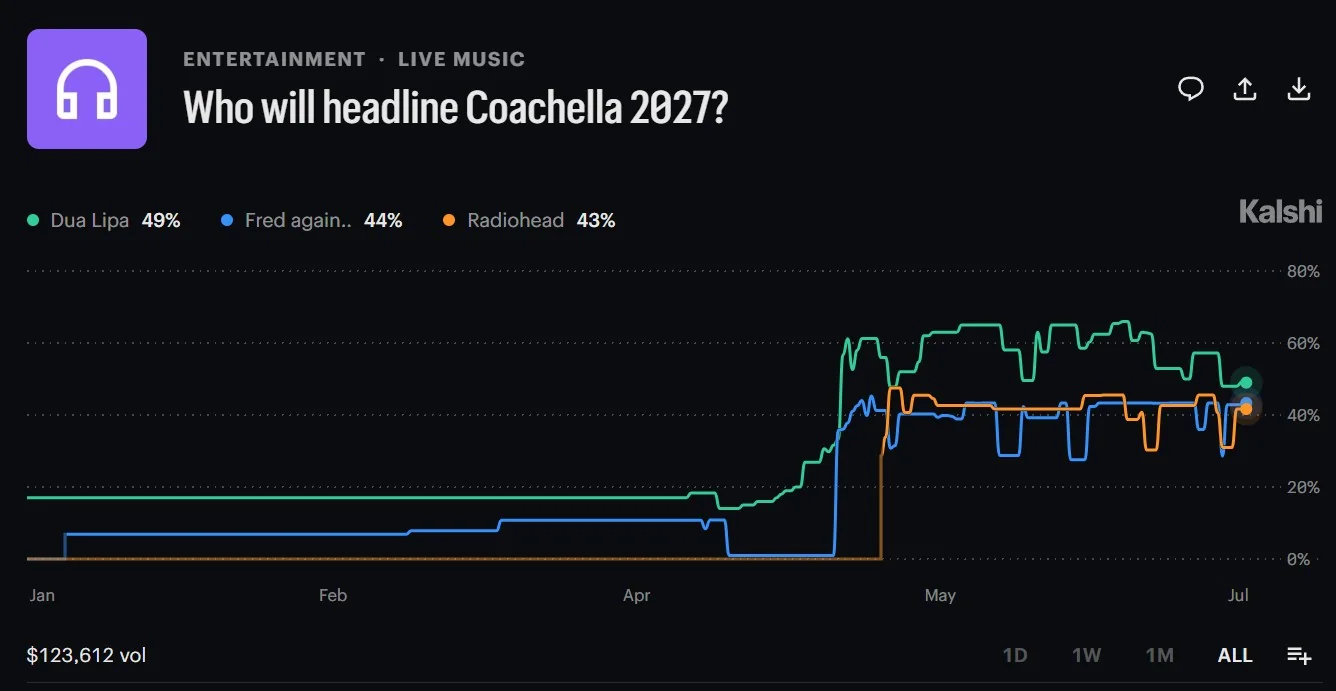
Prediction markets discovered music and the growth has been staggering. Kalshi traded around $70 million in music markets last year. This year it is over $400 million. You can now buy and sell contracts on Spotify streams, Billboard positions, Grammy winners, album sales, even which artist features on the next Drake record.
So the obvious question for anyone selling tickets is simple. Does any of this tell you what a seat is worth? After digging into it, my honest answer is no, at least not yet.
A quick note before we go further. We are leaving sports out on purpose. Betting on games is centuries old, so if you can wager on a team at a sportsbook, you have already had access to a market pricing that outcome. The only thing that changed is the format. A sportsbook sets the odds and you bet against the house. A prediction market lets traders set the price by trading against each other. What is actually new is that same exchange reaching non sports events like music.
Blind belief in authority is the greatest enemy of truth.
— Albert Einstein
You Can Trade the Charts Now
This is real activity, not a novelty. Kalshi now lets fans trade weekly streams on Drake, Justin Bieber, Bad Bunny and Taylor Swift. There are markets on album sales, on who lands the number one song, on Grammy results, on whether an artist announces a tour. Right now Bad Bunny sits as the heavy favorite to finish as Spotify's top artist of the year. Traders treat it like a sport, because in every way that matters to them, it is one.
The Number Is Softer Than It Looks
That $400 million headline deserves a second look. Prediction markets count a dollar for every contract, so a flood of penny trades can inflate the total in a hurry. The Super Bowl halftime opener alone accounted for about $110 million of it. Big money is moving. The topline is a marketing figure as much as a measure of real conviction.
The Record Is Not the Room
Here is the deeper problem. Every one of these markets measures recorded music. Streams, charts, sales, awards. None of them measures who will pay to stand in a room and watch. Those are different behaviors. A streaming heavy act can dominate the charts and still struggle to fill an arena, while a catalog act with modest current numbers can sell out a tour on loyalty alone. Chart position is a weak proxy for live demand and often a misleading one.
And the Count Can Be Faked
It gets worse. In 2026 traders botted Spotify streams to push a song where they needed it and the Kalshi market resolved and paid out on those numbers. Spotify caught the fake streams and stripped them out on July 1. By then the money was already settled. Spotify went on to demand that both Kalshi and Polymarket remove its logo. The lesson is blunt. If the underlying count is cheap to fake and slow to audit, nobody trading knows in real time what is organic and what is manufactured. Any ticket read built on that data inherits the fraud.
The One Real Bridge
There is one honest connection to live events and it is not the charts. It is the announcement markets. A contract on whether an artist announces a tour this year is a bet on whether a live event will exist at all, which is a genuine precursor to ticket demand. That is a signal a broker can actually use, because it is about the room, not the record.
So What Does It Mean
For now, prediction markets are a fast and public read on cultural momentum, not a reliable ticket signal. The number is inflated, the proxy is wrong and the data can be gamed. That does not make it worthless. It makes it something to watch rather than something to price against. When these markets start trading the room instead of the record and the resolution sources get harder to fake, the story changes. Until then, treat the hype as input, not as truth.
It is the kind of signal Popcorn will price the day it starts measuring the room instead of the record.
References
MOVE BEYOND
SIMPLE PRICING.
Professional ticket brokering is a 24/7 challenge. Popcorn is opening limited access to brokers who want to shape how the engine evolves. Join the start of an elite system to win back time and grow your business.